 I’m back again with another new short story. The last one I had written was “HOW ABOUT YOU, DELBERT ROBINSON?” which I posted on February 27th. That story had taken me six months to write, having started it in August of last year. Before that, I had written THE POCKET PAL’S GUIDE TO MURDER which I posted on June 9th of last year but had taken me over a month to complete. In between, I had written my annual Christmas story, THE TWO AND TEN…A CHRISTMAS GIFT EXCHANGE and posted it on December 20th. I believe that story was completed in two days. My new story, “Howard’s Sixteen Chairs,” was written in four days. That’s some kind of record for me, given the length of it.
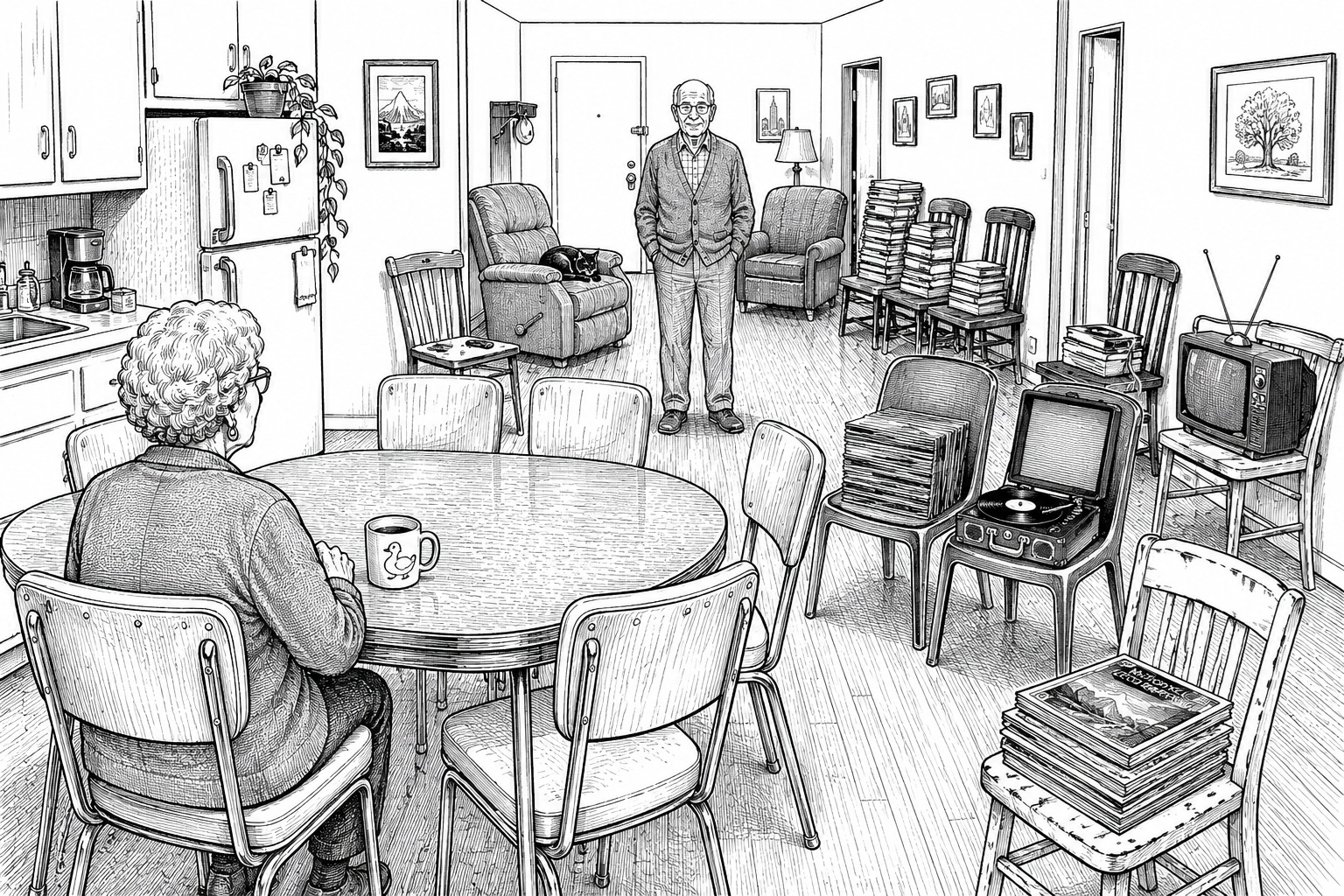
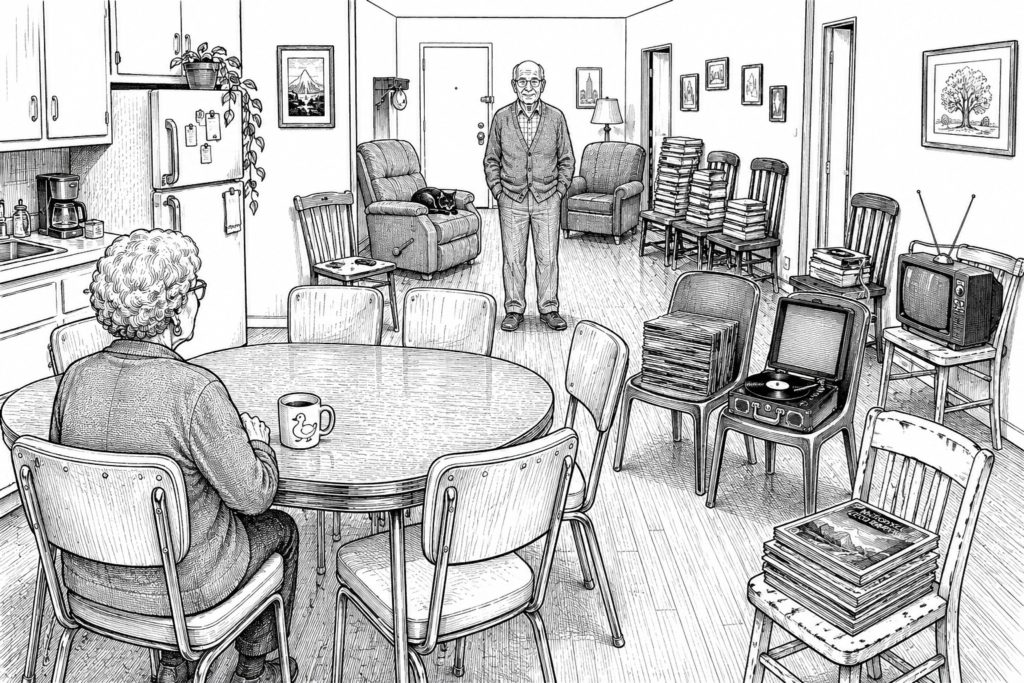
My current story is based on a radio conversation I heard this past weekend while driving up to Pembroke, Ontario for an MRI on my prostate. Everything is good, thank you for asking. I heard a conversation of two radio personalities talking about the male counterpart having sixteen chairs in a one bedroom condo. Once you read the story, you’ll understand why I had to take the challenge. I asked ChatGPT’s opinion on the story after I wrote it. I didn’t take any advice from ChatGPT but I did ask it to make an illustration for the story based on my suggestions. Here’s the illustration (click on it for a larger version):
Here’s my new story:
HOWARD’S SIXTEEN CHAIRS
BY
SCOTT HENDERSON
Howard Morgan owned sixteen chairs. The realization that Howard Morgan owned sixteen chairs was never questioned by Howard Morgan. He’d had them so long, being an accumulation over time, that he never gave it any real thought as to how many chairs was too many.
The thing about the sixteen chairs that might have been concerning to anyone was that Howard Morgan lived all alone in a one bedroom apartment. Oh, there was the cat, as well, if Howard came to think about it but, as he failed to contemplate the multitudinous number of chairs, he rarely factored the cat into the equation. There had been a dog before the cat and a dog before that dog and other previous dogs that probably constituted a multitudinous of canines if Howard’s memory served him correctly.
The issue with the dogs always boiled down to Howard’s insistence that they get down off the chair. It didn’t matter which chair it was because the dogs were not discerning. The cat however was and lay wherever it damn well pleased. Still, with sixteen chairs, it became somewhat of a battle with the dogs and Howard became discerning himself, tired of the conflict, and relegated himself to being a cat person after the last of the dogs had died off.
The cat’s favourite place for repose, of course, was whichever chair Howard gravitated towards at any given moment. Howard believed the cat had a sense that way. It was annoying. If Howard wanted to sit in his electric recliner he had to move the cat. If the cat was in Howard’s favourite chair at the table, Howard had to relocate himself and leave the cat be. If there were a magazine on a particular chair that Howard hadn’t finished reading then he’d be sure to find the cat stretched out on top.
There were sixteen chairs in the apartment. There were two recliners. The electric one was for Howard and the cat. The manual reclining version with a pull handle was for guests. Howard felt that he didn’t need a sofa. He never had that many guests and besides, he didn’t want to become one of those people who stretched out on the couch and fell asleep only to waken to a test pattern on the television or the volume too loud on the late, late, late, extremely late, early tomorrow morning movie. He also feared he might wake some night to a concerning heaviness in his chest only to discover that the cat was snuggled atop him.
In addition to the recliners there were six chairs around his kitchen table. Howard often thought he could get by with four but he didn’t want to break up the set. He’d had it for years. The blue formica top dinette with metal legs and vinyl padded seats on the chairs had belonged to his parents. It had weathered the years well. There was the odd coffee cup ring that never scrubbed away but Howard didn’t mind. He set mugs on top of the stains and no one noticed.
The yellow mug with the image of a duck always sat in one particular location and was only ever used when serving coffee to his friend, Gila. Howard invited his neighbour in a few times a week and she always sat in the same chair and drank from the same cup. Howard kept an overly large leather bound dictionary on the chair to prevent the cat from taking the spot. Before Gila arrived, Howard would remove the dictionary and make some version of the same joke to the cat.
“The word of the day is ‘don’t’. As in, don’t sit on Gila’s chair.”
“Today’s word is ‘no’. No, this seat is not for you. “
“Page 338, second column, fourteenth word down, ‘Good.’ Let’s use it in a sentence.” Howard would point at the chair and say “Gila, Good. Cat, not so good.”
Gila was Howard’s best friend. He liked her just as much as the cat. At least she wasn’t a chair thief. Gila only ever sat in one spot. It was eight steps inside his door and when you’re blind, like his friend Gila, the constant location of a familiar seat goes a long way. The fact that she was blind also prevented her from commenting on Howard’s fifteen other chairs which lulled him into sensing sixteen was probably not an inordinate number.
It just never came up. Well, not in a long time.
There had been the Tuesday evening poker game when the six chairs surrounding the table were taken up by Howard and other men. That was a long time ago, at least as far as Howard and the cat were concerned.
No one from the poker group ever commented on the quantity of chairs. It was their contents that focussed the conversation.
“You’ve got a nice collection of books, Howard,” one poker buddy would say while commenting on the piles covering two chairs lining one side of the living room. They were the small wooden kind that students used with their desks when Howard was younger. He had rescued them from his old alma mater primary school before it was torn down. He was a sentimentalist that way.
Another chum would comment on the stacks of records on another location. Howard had purchased two blue plastic chairs at a yard sale down the block. He hadn’t needed them but two boxes of records were perched on the chairs and Howard had made a bundle deal. It saved him from cluttering his apartment with shelves. He consolidated his records to one large stack on one of the chairs and a portable turntable with built-in speakers was housed on the other.
One chair stood alone between the two recliners. It was handy for drinks or remotes. Howard’s television stood atop another chair opposite his La-Z-Boy. No need either for end tables or a TV stand.
The Tuesday evening social had lasted almost a decade before the group began to thin out. Some of the other men had died. One had moved into assisted living. Another was taken in by his daughter in another town. The Tuesday crowd had dwindled to a number that represented less than a crowd. Two’s company only when there’s not poker stakes. It wasn’t fun anymore. Now, the only other chair at the table not occupied by Howard or the cat was allocated to Gila.
Gila had been Howard’s neighbour for many years now. She’d been around in the poker days and always kidded Howard about ‘the stench of old men’ in the halls. Howard didn’t feel insulted. He was an old man. He was eighty-five and if there was an old man smell then he probably embraced it without knowing.
Howard didn’t know how old Gila was. He never inquired and he knew the rule that you never ask a lady’s age. She couldn’t be much off the mark of Howard’s stage however if he thought about it at all.
He remembered his first interaction with Gila. He’d seen her around the building. It was hard not to miss an elderly blind lady with a cane. The cane was as unique as Gila. It wasn’t the expected slender white version used for tapping one’s way around. It was wooden and gnarled and Gila swung it wide like it was a weapon more than a guidance device.
“Can I help you with anything?” Howard had asked her one day when he saw her struggling with a bag of groceries and the key to unlock her apartment.
“Do I look like I need help?” she had snapped back at him.
“No, I guess you don’t,” he’d responded while trying not to feel offended, “but there’s a can of peas that seems to have bolted and is rolling off down the hall.”
Gila swung her cane in an arc trying to locate the escapee tin of vegetables. She nearly connected with one of Howard’s shins but he stepped aside quickly and scooped up the can.
“In my hand, straight ahead,” Howard offered.
Gila’s face softened. She reached out slowly until she connected with Howard’s outstretched hand. She retrieved the can and secured it back in her bag.
“Thank you, and sorry about the bark. Used to doing for myself. The name’s Gila.”
“Howard.”
“Well Howard, now we’ve been properly introduced and you’ve learned of my fondness for canned peas. I’d ask you in for coffee but all I know about you is your name is Howard and you smell like an old man. Sorry,” she quickly added, “I always say what’s on my mind. Shouldn’t, but I do.”
“No offense taken, I am an old man. Coffee would be nice but you’re right, you don’t know me, and all I know about you is your name and now the peas thing. And you’re…”
“Blind. It’s okay, go ahead and say it. No denying the obvious.” Gila finally extended her hand in greeting.
“I was going to say, you’re obviously a fan of coffee or have coffee on hand for those you eventually come to trust.” Howard grasped her hand and placed his other hand on the backside of her palm. He thought it would be more friendly. He hoped it wouldn’t come off as too intimate.
Gila laughed. “Smooth talker or a good liar,” she said after freeing her hand. “Nice to meet you, Howard.”
“610,” Howard responded.
“What’s that?” Gila asked in return.
“I’m in 610 in case you ever want to have that coffee. Of course, I can’t do a darn thing about the old man smell though. My place smells like me. Oh, and cat,” he quickly added.
“Howard in 610 with a cat. That’s two more things I’ve learned about you.”
Gila must have discerned enough from their brief conversation to be comfortable with Howard. An hour later she was rapping on the door to 610.
Gila always said she came to check out the cat but she kept coming back for the coffee. Howard always believed it was his sparkling personality but he never challenged her on that.
Howard never went to Gila’s. The invitation was never extended. Howard believed because she was blind that her apartment was arranged in a certain way for her convenience and probably he would just mess things up. Still, he never complained. Gila was good company.
Sometimes they would just sit and talk. They conversed about the news. They gossiped about the neighborhood or the building. They shared personal histories. Gila had lost her eyesight when she was a child. Some combined disease and fever. Howard didn’t understand it all. She still had memories of when she could see so whatever Howard described to her, she had reference. She’d never married.
Gila had spent a lifetime as a teacher. She worked with other blind people. She taught them braille. She read to them from texts also in braille. She covered a lot of subjects. She taught a lot of students. Some were children. Some were adults. Some were born without sight and others had lost that sense later on. When she retired, she found a small career recording books on tape. Later it was CDs. Then it became digital. That’s when she called it quits. She had enjoyed the fruits of her labour in a format she could hold in her hand. It always felt like she had accomplished something. Digital was nothing. You couldn’t touch it. Somehow, the magic was gone from it.
Howard was fascinated that this woman who shared coffee with him while seated on one of his sixteen chairs had once had a role in creating audio books. The idea that this person who always spoke her mind, even when she knew she shouldn’t, had products out in the world of her recorded voice, spurred him to track some down.
He tried the library without success but was referred to a local bookstore with an audio books section. They had none but they could order some in. There was some confusion in the beginning when he asked for books by Gila Kovacs and they could find no listings. Howard realized his mistake and asked for books read by Gila Kovacs. That narrowed down the search. Still, many were out of print. In the end, he ordered four and the store called him when they were in.
Gila’s reading voice was slow, smooth, and methodical. She pronounced every word as it should be heard and provided proper inflection and narration. Two had been mystery books and two had been romance. Howard lay in bed at night with the sounds of his portable CD player broadcasting Gila’s voice from its location on the wingback chair in the corner of the room. Usually Howard’s dirty clothes were piled there until they made a load for laundry. Now, he tossed them on the floor beside the bed. Out of sight, out of mind, he thought.
It took him a long time to get through the four books on CD. He would always fall asleep listening to Gila and would have to start up the next night. Howard never told his blind neighbour that most nights her voice often lulled him into slumber.
Howard’s life story didn’t have any of the intrigue that Gila’s had. He realized at his age he had more behind him than he had ahead.
He’d married once. In reality, he’d been married twice but it was to the same person. The first time was right out of high-school. They’d both been too young but the attraction was there and they both wanted to act on it. Five years later, they understood they were too unlike one another.
Howard didn’t like the term “irreconcilable differences” but that’s what his lawyer put forward for terms of the divorce. It was all very amicable. They went their separate ways. Five years later they discovered each other again and after a whirlwind romance of two more mature persons, they went to the Justice Of The Peace and made another try. That time it was less than a year. The attraction wore off and they were still too different from one another. Finally, Howard understood that being different persons was the real gist of the irreconcilable differences. She moved away. He never saw her again.
Gila thought the notion comical of marrying the same person twice only to discover that you were correct the first time you separated. Gila usually said what she was thinking but she kept her musing on that one from Howard.
The fascination with chairs started when Howard was hired on by a furniture company. He was very strong when he was younger and his back, and his arms, and his legs always held true. At eighty-five he felt some kind of pain in every joint. He bruised easily. He couldn’t close his fingers tight enough to make a fist. Arthritis was the visitor that moved in and never left. At least it didn’t need its own chair.
His strength early on seemed never-ending. He could lift almost anything unless it was too bulky and required a pair of movers. Chairs were easy, though. He could heft them over his head. Smaller ones he could put together and carry in a stack. He’d often try and see how many he could take on at a time.
He observed sometimes that chairs were like people. It was like they had personalities of their own. They could be short or tall or large. They could be overstuffed or sagging in the middle. They reminded him of people he knew. The sagging part reminded Howard of himself.
Now when he looked around at the unoccupied chairs, he was reminded of the people who had come and gone; the dinette and the poker crew especially. He was glad for Gila. More life in that one seat than all the other ghosts in the apartment. He never wanted to think of a time when that chair might become a vacant seat.
When Howard got older and could no longer move like he used to, in more ways than one, he moved into management. He taught others how to properly move furniture and other items. After a while, he branched out and opened his own inner-city moving company. No more long-haul moving. All of his employees were educated in Howard’s philosophy of showing respect to the belongings of others. Eventually he retired from that and sold out to someone else who wanted to get off the road and get into the office.
Howard’s last act was to rescue an old white wooden chair that had gone unclaimed for a few years. Someone had taken it off a truck and stored it the warehouse where it stayed hidden behind stacks of empty moving boxes. It was Howard’s sixteenth chair. He gave it a prominent spot in his home. It found new life in his bathroom where it stored a hoard of National Geographic magazines. He liked to peruse them when nature called. He liked the mystery of foreign countries. He often thought of the places he’d go if only he could. Now he had obligations to the cat and to Gila.
The realization that Howard Morgan owned sixteen chairs was never questioned by Howard Morgan…until one day. One afternoonhe accidentally turned on the radio portion of his portable CD player when swapping out one of Gila’s narrated books. He picked up on a conversation from two radio personalities he recognized from the drive home time slot. He only ever listened for the news because the patter between the pair was never interesting and lacking in humor. That day the conversation caught his attention.
“You own eleven chairs?” the female asked.
“Yes, I do,” the male responded.
“That’s crazy! Don’t you live in a one bedroom apartment?”
“Yes, I do.” The male’s responses seemed preprogrammed.
“That’s way too many, man. Besides, eleven’s an odd number. You need to downsize.”
“Or get another,” he replied.
“No way. Who would want to own twelve chairs? Even eleven’s too many.”
Howard switched off their banter. It was not just unfunny but it was bothersome. It made him think of his own sixteen chairs. He thought about listening in again to find out why the male had eleven chairs but it only made Howard want to question further why he owned so many himself.
“Is eleven chairs too many for one man?” he found himself asking aloud. “What does that say about me and my sixteen?” He tried to shut out the question but it continued to nag at him. It nagged at him while he sat on one of his kitchen chairs eating his dinner. It nagged at him while he lay back in his recliner and tried to watch television. It nagged at him while he lay in bed and listened to Gila’s voice emanating from the direction of the wing-chair. Somehow the sound of her speech failed to aid him easily into sleep. He could not escape the question of the sixteen chairs.
“Gila, how many chairs is too many?” He couldn’t let it go and so the next day he asked the only person he knew who would give him a straight direct answer without replying immediately with a question of her own.
“How should I know Howard. I’m blind. Even one misplaced chair is one too many when you can’t see it.”
That was the type of response he expected from her. Gila was always right to the point. This Gila sipping coffee from the yellow mug with the duck on it was vastly different to the one who spoke to him from the CD player on the chair in his bedroom.
“Why do you ask?” Gila continued. “Do you have a chair problem, Howard?” Direct again.
Howard thought about it for a moment. He didn’t always take the straight route like his friend. His thinking was more circuitous.
“Would you think eleven is too many?” He remembered the conversation from the radio and thought that was a good jumping off point.
“That’s a lot of chairs, Howard. Are you telling me you have eleven chairs? Not that I’m judging,” she quickly added.
“No, I’m telling you I have sixteen chairs,” he responded in almost a whisper.
There was no expression in Gila’s face. Howard always found it hard to read her reactions. There wasn’t shock but he didn’t note acceptance either.
“I don’t know how to respond to that,” she finally said. “Except to say, prove it. My apartment’s the same layout as yours. Give me the tour of your sixteen chairs, Howard Morgan.”
Howard obliged. He took her by the arm and walked her throughout all the rooms. He placed her free hand on top of each chair and provided their history. He detailed everything on every chair. She ran her hand across the books and fingered some of the records. Howard shocked her only once when he reached out her hand to touch the cat perched upon the National Geographic magazines. She hadn’t been surprised by the number of chairs or being escorted into Howard’s bedroom and then the bathroom. She knew where she was at every moment because the footprint of her own lodgings were identical to his. She just had forgotten about the cat and its appearance on the sixteenth chair was something she hadn’t expected. They both laughed. For Howard’s part, he was temporarily glad that Gila was blind and could not make out the CDs in the bedroom that carried her voice. Howard would have had some uncomfortable explaining to do.
Gila never did answer Howard’s question about the quantity of chairs. Instead she focused on the other things she had discovered in their journey through his collection.
She asked about the records and made requests. Howard obliged.
She asked about the books and she made a point to remember some of the titles. She wondered if there were braille versions.
She questioned him about the National Geographics. He told her about his fascination. She asked him to read some of the articles to her. Again he obliged. His voice wasn’t like hers. It was faltering and slow. She didn’t object. Eventually he became more relaxed and he inflected some of his wonder into his readings.
The days they had coffee were no longer just coffee. He played recordings for her. He read from the magazine stash in the bathroom.
Sometimes they would go out together. She would leave her cane behind and allowed herself to be escorted by the arm. They went grocery shopping together. They went to the park. Howard would describe the people, and the sights, and the birds. He got to be very good at recognizing their species. The National Geographic magazines had come in handy.
They continued their coffee afternoons. Occasionally they would go out for coffee to a place that Howard knew. Gila would repeat conversations to him that she overhead. His hearing was not as good as hers.
It was a beautiful friendship and the perfect relationship for their time of life. Records, books, magazines, coffee, and sixteen chairs. Oh, and one discerning cat.
The realization that Howard Morgan owned sixteen chairs was never questioned again by Howard Morgan. He realized that Gila had never answered him when he asked her about the amount. He guessed it did really matter after all. Probably sixteen chairs were sufficient.
The sixteen chairs proved to be just the right amount…on two occasions.
On Howard’s ninetieth birthday his friends came and occupied the sixteen chairs. Gila occupied her customary spot. All of the records and books and magazines and other items had been relocated to storage a few days before to make room.
Howard would have been pleased.
Howard had died four days before he would have been ninety.
Howard had awoken in the night to that concerning heaviness in his chest he had always feared. He gave a glance to the cat lying on the pillow next to him and realized immediately something was wrong. He had just enough strength to make it to the living room. He thought maybe if he elevated his feet while reclining that the pain would go away. It did not. Howard slipped away peacefully in his favourite chair. The cat sat in the manual version and mewed lowly throughout the night.
Gila could not rouse him the next day when she knocked at his door. It wasn’t like Howard not to answer. She became concerned and rapped loudly again with the head of her cane. She began to panic and felt her way along the hall and began rapping on other doors until someone answered. The neighbour called the building manager. The manager called the police. The police called for the paramedics. It was too late. Howard was gone. They found him in the electric recliner with the cat curled up on his lap.
Four days later Gila hosted a combination celebration of life and ninetieth birthday party. Nice things were said about Howard. Tears were shed. No one said anything about the quantity of chairs.
Howard had left a will. It was found among the magazines in the bathroom. It seemed appropriate. He was on his last journey.
He didn’t have much. He insisted everything be sold and the proceeds be donated to a local animal shelter. To Gila, he left the yellow mug with the duck on it, his cat, and a chair of her choice. His only stipulation was that it was not one from the dinette because he wanted the set to remain complete.
Gila selected the white wooden chair from the bathroom. It had secretly been one of Howard’s favorites and the cat had enjoyed it. After the celebration she asked one of the attendees to carry it down the hall and leave it outside her door.
When she was alone she dragged the chair inside and then stopped for a moment to get her bearings.
“Cat, are you here?” she asked aloud.
As if in reply, the cat meowed.
“I brought you something.”
Gila felt out in front of her and then to both sides. She counted as she made her away. She touched the backs of fifteen chairs that lay out a path from her kitchen to her living room. There were breaks in the line for the bathroom and at the end for the entrance to her bedroom. There was also a side path of two chairs that led to the kitchen counter. She felt out with her fingers and found the yellow mug. She held it to her face and thought of Howard. It still smelled of coffee.
Struggling only slightly, she dragged Howard’s sixteenth chair down the line and placed it in her bedroom next to her bed. She reached for a spare pillow and placed it on the chair for the cat.
Gila patted the pillow and called for the cat. It came running and hopped up.
She stroked the cat until she heard it purr. She turned away and then felt back along the chairs until she reached her apartment door. Then she turned again and listened. She could hear the cat’s purring from there.
She spoke quietly to the room in her soft narrator voice.
“No, Howard Morgan, sixteen chairs is not too many. They’re just enough.”
 I’m back again with another new short story. The last one I had written was “HOW ABOUT YOU, DELBERT ROBINSON?” which I posted on February 27th. That story had taken me six months to write, having started it in August of last year. Before that, I had written THE POCKET PAL’S GUIDE TO MURDER which I posted on June 9th of last year but had taken me over a month to complete. In between, I had written my annual Christmas story, THE TWO AND TEN…A CHRISTMAS GIFT EXCHANGE and posted it on December 20th. I believe that story was completed in two days. My new story, “Howard’s Sixteen Chairs,” was written in four days. That’s some kind of record for me, given the length of it.